In a world drowning in state-sanctioned control and corporate fascism, where "antifascism" has been co-opted into performative protests and government-approved dissent, the real resistance has always simmered in the shadows of faith. Sectarian Christianity those splintered, independent expressions of Christ's gospel outside the mainstream denominations stands as the original blueprint for subverting authority. Far from the polished pews of institutionalized religion, these groups embody a raw, unifying devotion to Jesus' teachings: a radical call to prioritize divine law over man's corrupt edicts. Christ himself was the ultimate subversive, flipping tables in the temple, healing on the Sabbath in defiance of religious elites, and declaring that his kingdom is not of this world. As the apostles echoed in Acts 5:29, "We must obey God rather than men." In Indiana, this spirit isn't just rhetoric; it's lived history, etched into communities that have quietly resisted government overreach while clinging to the cross.

Padanaram Settlement: Biblical Communalism Against the System
Nestled in the hills of Martin County, Padanaram Settlement often called God's Valley emerged in 1966 as a direct challenge to the alienation of modern America. Founded by Daniel Wright, a former lay minister disillusioned with organized religion's corruption and the chasm between rich and poor, this intentional community drew from biblical roots to create a self-sustaining haven. Wright, after a visionary experience in 1960, purchased land and gathered followers to live out "Kingdomism" a philosophy of shared resources, hard work, and the Golden Rule, eliminating the need for excessive laws or hierarchies. "One that won't work, shall not eat," Wright preached, echoing 2 Thessalonians 3:10, while insisting, "If we have money for steak, we all eat steak. If not, we all eat hamburger."
From its early days of primitive lodges and communal meals, Padanaram faced harassment from locals and authorities, fueled by rumors of communism and immorality. County officials refused to maintain roads, and media smears painted them as a threat, much like the scrutiny that followed events such as Jonestown or Waco. Yet, this only underscored their antiauthoritarian ethos: rejecting societal norms for a biblical equality where wisdom, not government, guides. Wright famously turned the tables, calling America "the biggest cult he’d ever seen." By the 1970s, with a population peaking at 200, they built a thriving sawmill economy, helping addicts and outcasts a quiet subversion of the state's punitive systems. Even as it evolved post-Wright's 2001 death, incorporating outside jobs while maintaining communal bonds, Padanaram remains a testament to Christ's call for unity beyond man's divided world.

The People's Temple: Early Seeds of Social Justice Rebellion in Indianapolis
In the heart of Indianapolis, another sectarian spark ignited in 1955 with Jim Jones' Peoples Temple. Born in rural Indiana, Jones founded the group as a response to racial segregation and economic injustice, blending Christian communalism with socialist ideals to challenge the status quo. At a time when Indianapolis enforced de facto segregation in schools, parks, and businesses, Jones integrated his congregation, attracting mostly African Americans with sermons on tolerance, social responsibility, and "apostolic socialism." He ran soup kitchens feeding thousands monthly, provided shelter and job aid, and fought for civil rights as director of the city's Human Rights Commission.
Jones viewed capitalist America as a "racist, fascist" Babylon, prophesying government-led persecution and nuclear threats. His teachings subverted authority by equating Jesus with communism, rejecting the Bible's use as a tool of oppression, and urging communal living where members donated all for the collective a direct echo of Acts 4:34-35. Facing death threats, hate mail, and financial scrutiny from authorities, the Temple relocated in 1965, but its Indiana roots planted seeds of antifascist resistance: a faith-based stand against systemic racism and state control, prioritizing Christ's unifying love over divided laws.
Amish Communities: Quiet Defiance in Northern Indiana
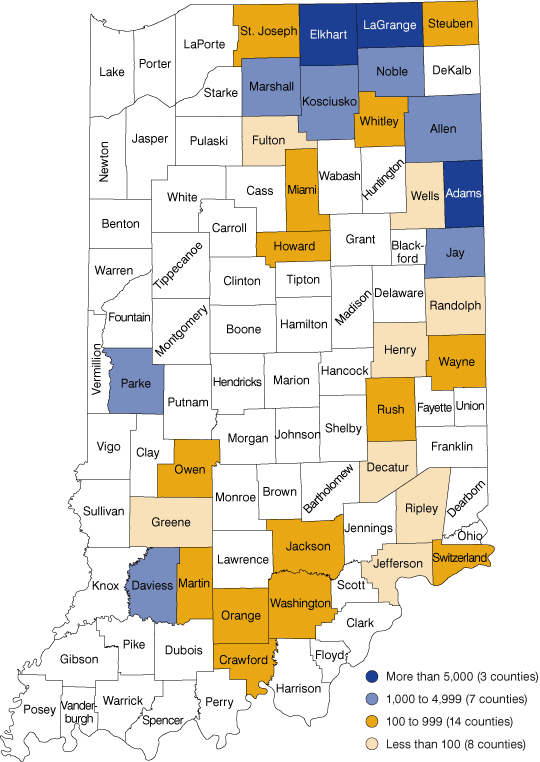
No discussion of Indiana's sectarian antifascism is complete without the Amish, whose settlements in counties like LaGrange and Elkhart form one of the largest in the U.S. Descended from 16th-century Anabaptists, the Amish emphasize separation from the world, pacifism, and church authority over state dictates a core belief leading to repeated clashes with government. In Indiana since the 1840s, they've resisted compulsory education beyond eighth grade, military service, and Social Security taxes, viewing them as intrusions on their faith.

Recent examples highlight this subversion: In Adams County, Amish families sued over mandates to connect to municipal sewers, arguing it violated their First Amendment religious freedoms. During rumspringa the youth's exploratory phase before baptism – encounters with law enforcement often turn defiant, with parties involving alcohol and drugs seen as a "game" against intrusive police, rooted in the belief that church, not state, holds supreme authority. Incidents like rock-throwing at officers in nearby Ohio settlements with Indiana ties underscore this nonviolent yet unyielding resistance. By living simply, self-sufficiently, and communally, Indiana's Amish subvert fascism's grip, adhering to Christ's teachings of nonresistance and love while rejecting man's coercive laws.